It's Not Magic — But It's Close
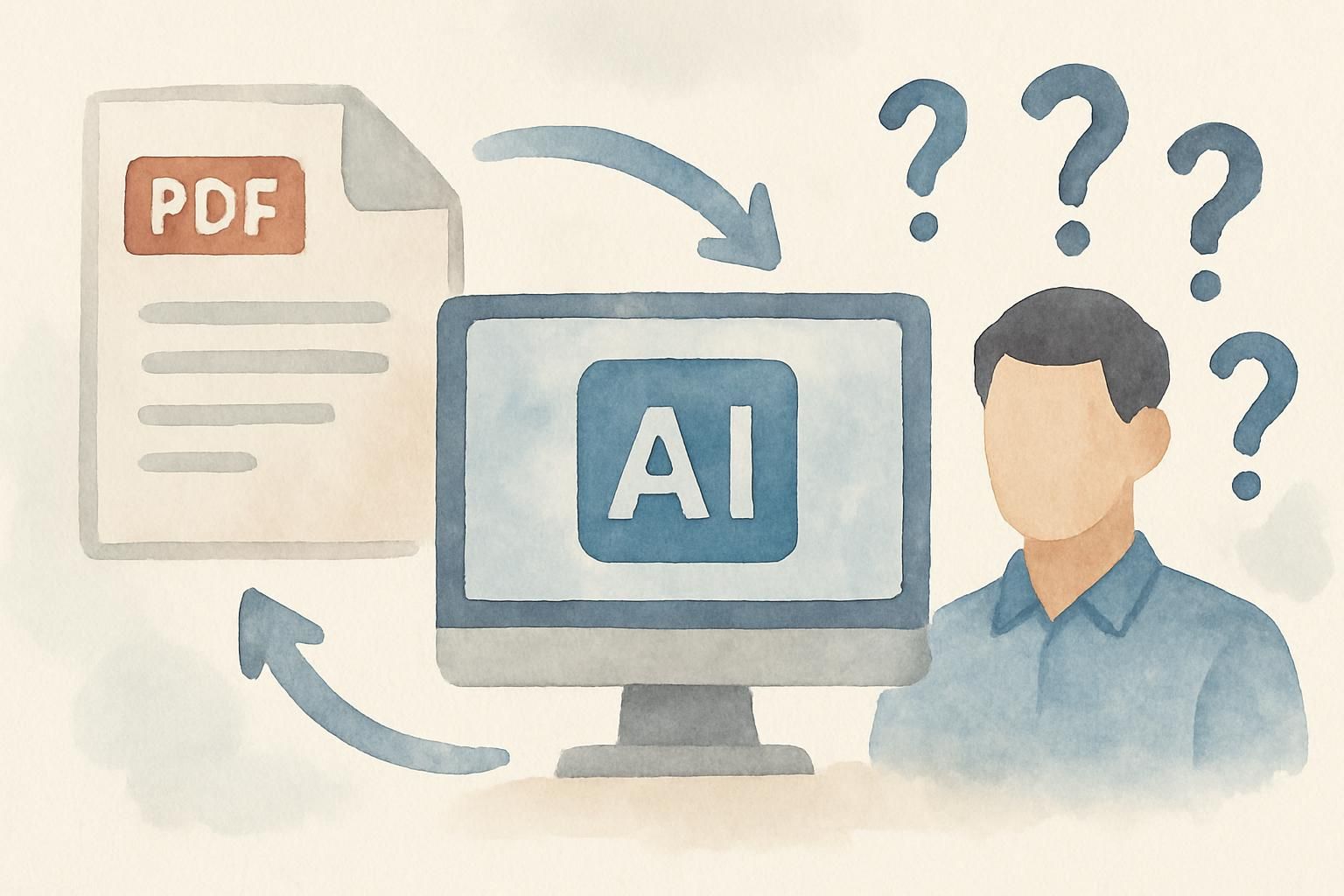
You upload a PDF. Thirty seconds later, you have 15 multiple-choice questions with correct answers and realistic wrong options. How does an AI quiz generator actually do that?
Understanding what happens behind the scenes helps you use the tool better — and get higher quality quizzes. Here's the step-by-step process, no computer science degree required.
Step 1: Text Extraction
Before the AI can read your document, it needs to extract the text. A PDF isn't just text — it's a layout format that includes fonts, positioning, images, and formatting instructions.
The extraction process:
- Digital PDFs (typed documents, exports from Word/Google Docs) have embedded text that can be extracted directly. This produces the cleanest results.
- Scanned PDFs (photos of printed pages, handwritten notes) require OCR (optical character recognition) to convert images of text into actual text.
- Mixed PDFs (slides with text and diagrams) get their text extracted; the AI works with whatever readable text is available.
Tip: For best results, upload digitally created PDFs. Clean text input produces sharper questions.
Step 2: Content Analysis
Once the AI has the text, it analyzes the content to identify:
- Key concepts — the main ideas, definitions, and facts in the material
- Relationships — how concepts connect to each other (causes, effects, categories, sequences)
- Hierarchy — which information is central and which is supporting detail
- Terminology — subject-specific vocabulary that should appear in questions
This is where the AI's language understanding matters. It doesn't just pick random sentences — it identifies what's important in the text based on context, emphasis, and structure.
Modern large language models process text using transformer architecture, which excels at understanding context and relationships between words across long passages.
Step 3: Question Generation
With the content mapped out, the AI generates questions that test understanding at different levels:
- Recall questions — "What is [term]?" or "Which of the following is true about [concept]?"
- Comprehension questions — "Why does [process] occur?" or "What is the relationship between [A] and [B]?"
- Application questions — "Based on [principle], what would happen if...?"
These levels align with Bloom's taxonomy, the framework educators use to classify learning objectives from basic recall to higher-order thinking.
Each question is anchored to specific content in your PDF. The AI doesn't invent information — it creates questions from what's actually in your document.
Step 4: Distractor Generation
This is the hardest part of quiz creation — and where AI shines. For each question, the AI needs three wrong answers (distractors) that are:
- Plausible — they sound like they could be right to someone who didn't study carefully
- Distinct — each distractor tests a different misconception or knowledge gap
- Non-overlapping — the distractors don't accidentally include or imply the correct answer
How does the AI create good distractors?
- Related concepts: If the correct answer is "mitochondria," a distractor might be "ribosomes" — a different organelle that a student might confuse
- Partial truths: Answers that are partially correct but miss a key detail
- Common misconceptions: Errors that people typically make about the topic
- Reversed relationships: Swapping cause and effect, or confusing two related processes
Research on multiple-choice item writing confirms that well-crafted distractors are what separate effective assessments from trivial ones.
Bad distractors (like obviously random answers) make a quiz useless. Good distractors make a quiz a genuine test of understanding.
Step 5: Quality Checks
Before presenting the final quiz, the AI validates:
- Every question has exactly one unambiguous correct answer
- Distractors don't accidentally contain the correct answer
- Questions cover different parts of the source material (not all about the same paragraph)
- The language is clear and grammatically correct
- Questions are answerable from the source material alone
What This Means for You
Upload better PDFs, get better quizzes
Since the AI works from your text, the quality of the input directly affects the quality of the output:
- Focused documents (one chapter, one topic) produce more targeted questions than broad overviews
- Well-structured text with clear headings and paragraphs gives the AI better signals about what's important
- Documents up to 20 MB are supported. The free version processes the first 3 pages — usually enough for a single lesson or chapter section
AI questions vs. human-written questions
| Aspect | AI-generated | Human-written |
|---|---|---|
| Speed | 30-60 seconds | 30-90 minutes |
| Consistency | Same quality every time | Varies with fatigue/time |
| Distractor quality | Good across subjects | Depends on expertise |
| Content coverage | Systematic | May miss sections |
| Creativity | Based on patterns | Can be more creative |
| Cost | Free | Your time |
AI-generated questions aren't perfect — a subject expert will write more nuanced questions for high-stakes exams. But for study practice, formative assessments, and self-testing, AI questions are more than good enough — and they're ready in seconds instead of hours.
How to Get the Most From AI Quiz Generation
Upload one topic at a time. A 5-page chapter produces better questions than a 50-page textbook. The AI can focus its analysis on a narrower set of concepts.
Use PDF exports, not scans. If you have the original digital document, export it as PDF rather than printing and scanning. Digital text extraction is more reliable than OCR.
Check the first quiz, then adjust. If the questions focus too much on one section, try uploading just the pages you want tested. The free version processes 3 pages, so choose the most important ones.
Retake for retention. AI-generated quizzes are just as effective for active recall as human-written ones. The retrieval practice is what matters, not who wrote the question.
Frequently Asked Questions
How accurate are AI-generated quiz questions?
AI generates questions directly from your document's content, so accuracy depends on the source material. For factual, text-based content, accuracy is high. The AI doesn't invent information — all questions are grounded in your PDF.
Can AI generate questions for any subject?
Yes. AI quiz generation works well for any subject with text-based content: science, history, literature, law, medicine, and more. Subjects heavy in formulas or visual diagrams may produce fewer questions.
How is this different from a question bank?
Question banks contain pre-written generic questions. AI quiz generation creates questions from your specific material — your lecture notes, your textbook chapter, your study guide. The questions match exactly what you need to learn.
Will AI replace human-written exams?
Not for high-stakes assessments. AI-generated quizzes are ideal for practice, self-testing, and formative checks. For final exams or certification tests, human review of questions is still important.
Sources
- Karpicke, J. D., & Blunt, J. R. (2011). Retrieval practice produces more learning than elaborative studying. Science, 331(6018), 772-775.
- Prevost, L. B., et al. (2016). Misconceptions as diagnostic tools in biology assessment. CBE—Life Sciences Education, 15(4).
- Armstrong, P. (2010). Bloom's Taxonomy. Vanderbilt University Center for Teaching.
- Vaswani, A., et al. (2017). Attention is all you need. Advances in Neural Information Processing Systems.
Try It: PDF to Quiz in Under a Minute
Curious how it works with your material? Upload any PDF to CramZap and see the result. No sign-up required to take the quiz — you'll have 15 questions ready before you finish reading this sentence.
Notes in. Questions out. That's AI doing the heavy lifting so you don't have to.