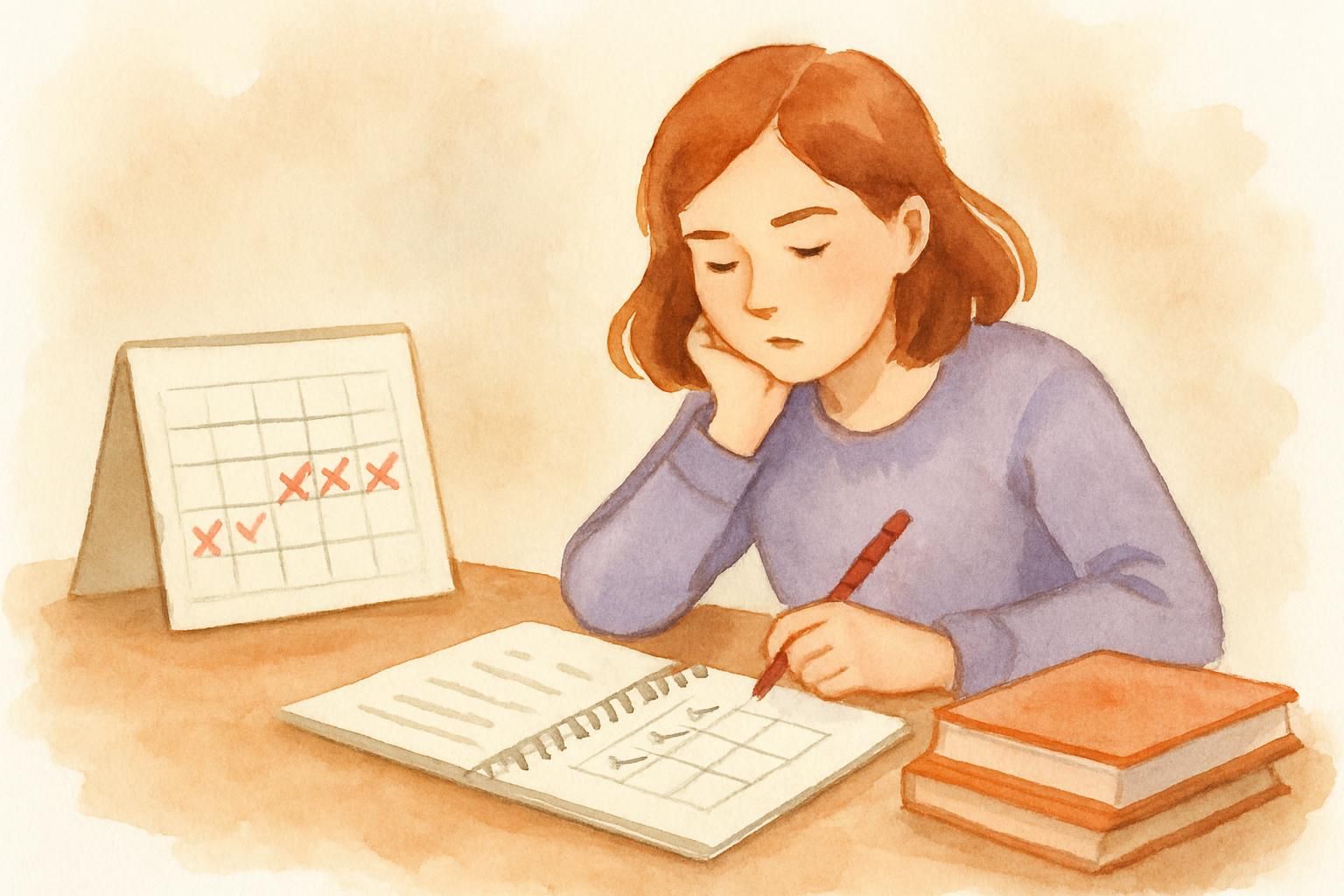
Finals Week Doesn't Have to Feel Like a Disaster
Three exams in two days. Six chapters per exam. A semester's worth of lectures compressed into one desperate all-nighter with cold coffee and diminishing returns.
Every college student knows this feeling. And every college student handles it the same way: reread the notes, reread the slides, stare at highlighted text until the words blur together, and hope something sticks.
Here's the problem: rereading doesn't work. Not because you're bad at studying — because rereading is bad at creating memories. Your brain needs to retrieve information to remember it, not just look at it again.
The fastest way to switch from passive reviewing to active retrieval? Turn your lecture notes into practice quizzes and test yourself before the exam does.
The Finals Study Plan That Actually Works
Week before finals: build your quiz library
For each exam, gather your source materials:
- Lecture slides (download as PDF from your LMS)
- Your typed or handwritten notes (export or scan to PDF)
- Study guides from your professor
- Textbook chapters you're responsible for
Upload each PDF to CramZap.com to generate a practice quiz. One quiz per lecture or chapter keeps questions focused. The free version processes the first 3 pages per upload — that's usually one lecture's worth of material.
5-4 days before: first pass
Take every quiz once. Don't study beforehand — the point is to discover what you already know and what you don't.
For each quiz, sort questions into three categories:
- Nailed it — you knew the answer instantly
- Got it, but hesitated — you were unsure but chose correctly
- Missed it — wrong answer or total blank
The "hesitated" and "missed" categories are your study priorities for the remaining days.
3-2 days before: targeted review
Go back to your notes for the concepts you missed. Read the relevant sections — but don't stop there. Retake the quizzes. The questions you missed last time should feel different now. Some you'll get right. Some you'll miss again. The ones you miss twice? Those need extra attention.
Day before: final run
Take all quizzes one more time. By now, you should be scoring 80%+ on material you've been spacing out over the week. The questions you still miss are the ones to review in your final study session.
Exam morning: confidence check
One quick pass through your weakest quiz. Not to cram new information — to activate what you've already learned. Walking into an exam having just retrieved the key concepts puts your brain in recall mode.
Why This Works Better Than Cramming
Spaced retrieval beats massed study
A 2006 meta-analysis by Cepeda and colleagues found that spreading study sessions over multiple days produced significantly better retention than concentrating the same total time into one session. The effect was consistent across subjects and age groups.
Cramming feels productive because the material seems fresh in the moment. But that freshness fades fast. Information retrieved multiple times across multiple days builds stronger memory traces than information read once for three hours.
Testing reveals what you don't know
When you reread notes, everything looks familiar. You think you know it. Then the exam asks a specific question and you realize recognition isn't the same as recall.
Practice quizzes solve this by forcing specific retrieval before the exam. Every wrong answer is a signal — a precise location in your knowledge that needs work.
Active recall strengthens memory
Every time you successfully retrieve a fact from memory, the neural pathway to that fact gets stronger. Research by Karpicke and Blunt (2011) demonstrated that retrieval practice produced better performance than elaborate studying — even on questions requiring conceptual understanding, not just memorization.
The College Student's Quiz Schedule
| Days before exam | Action | Time per subject |
|---|---|---|
| 7-5 days | Upload notes, take first quiz | 15 min |
| 4-3 days | Review missed topics, retake quizzes | 20 min |
| 2 days | Take all quizzes again | 15 min |
| 1 day | Final review of weak spots | 10 min |
| Exam morning | Quick pass through hardest quiz | 5 min |
Total: ~65 minutes per subject spread across a week. Compare that to a 4-hour cramming session that produces worse results.
Subject-Specific Tips
STEM courses (biology, chemistry, physics)
STEM exams often test processes and relationships, not just definitions. When you upload lecture notes:
- Focus on chapters that explain mechanisms (how things work)
- The AI will generate questions about cause-and-effect relationships
- Pay extra attention to questions you get wrong about processes — these are high-value exam topics
Humanities (history, literature, philosophy)
Humanities exams test your ability to connect ideas across readings. Upload:
- Lecture notes that summarize key arguments
- Study guides that list important themes, dates, or figures
- Your own notes are often the best source — they contain what your professor emphasized
Social sciences (psychology, sociology, economics)
These subjects blend memorization with conceptual understanding. Upload:
- Textbook chapter summaries (definitions + theories)
- Lecture slides with key studies or experiments
- Pay attention to questions about research findings — professors love testing these
Common Finals Mistakes to Avoid
Studying everything equally. You don't need to spend the same time on material you already know. Use quiz results to identify weak spots and focus there.
Switching subjects every 30 minutes. Some interleaving is good, but constant switching doesn't let you build momentum. Spend at least an hour per subject before moving on.
Pulling an all-nighter. Sleep consolidates memory. A well-rested brain with 80% coverage will outperform an exhausted brain with 100% exposure. Study smart during the day, sleep at night.
Only reading the professor's slides. Slides are outlines, not study materials. Your notes, the textbook, and practice questions fill the gaps between bullet points.
Skipping practice tests because "I already know this." If you can't answer the question without looking at your notes, you don't know it yet. The quiz will tell you the truth.
Study Groups + Shared Quizzes
Every CramZap quiz gets a unique shareable link. Use this for study groups:
- Each group member uploads notes from a different lecture
- Share quiz links in the group chat
- Everyone takes all quizzes
- Meet to discuss the questions people struggled with
This divides the prep work while giving everyone access to practice tests for the full exam scope.
Your Finals Start Now
You have the notes. You have the textbook. You have lectures recorded or slides downloaded. Don't wait until the night before to discover what you don't know.
Upload your first PDF to CramZap, take the quiz, and start building real recall — not false confidence.
The exam is coming either way. The only question is whether you walk in knowing what you know, or hoping you remember what you read.
Notes in. Questions out. Finals handled.